Career Realism
Tap to enlarge
Career Mode rebuilt from the ground up — scouting, transfers, simulation, player growth, awards and board logic tuned for long-term realism.
Your Career Mode, Rebuilt
Career Realism is a deep overhaul of FC 26 Career Mode — the systems EA oversimplifies in the base game. It is included in EUROPEAN MOD 26 with no separate install and touches hundreds of internal parameters across every major Career system. Scouting is no longer a cheat code for free wonderkids. Transfers require negotiation and strategy. Simulated seasons produce believable tables. Player careers unfold over many seasons. The result is a manager save that punishes shortcuts and rewards long-term planning — closer to real football than the default game.
- Included with EUROPEAN MOD 26 — no separate install required
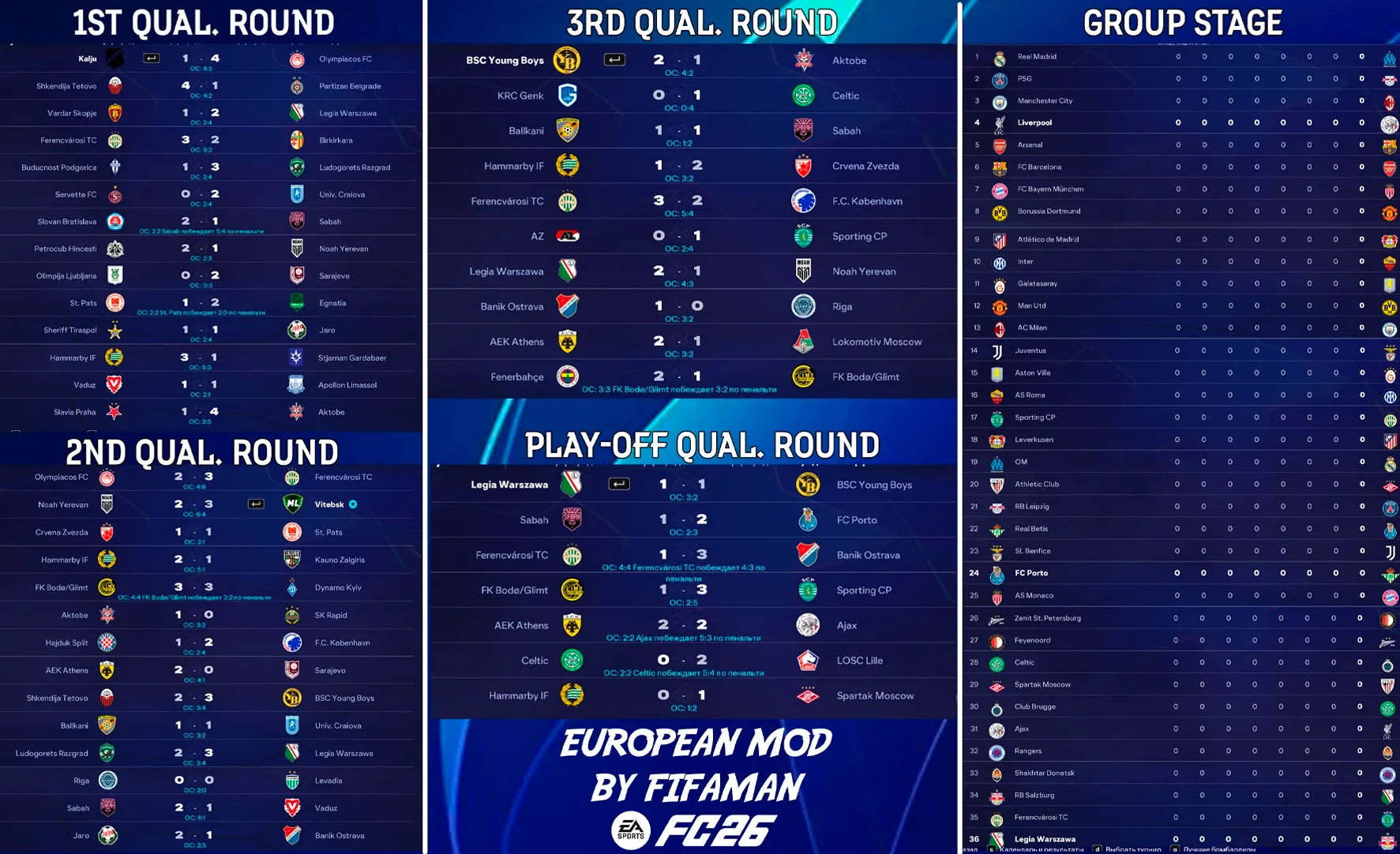
- Designed for European Career Mode with 22 added leagues and 377 clubs
- Hundreds of tuned parameters across scouting, transfers, simulation and careers
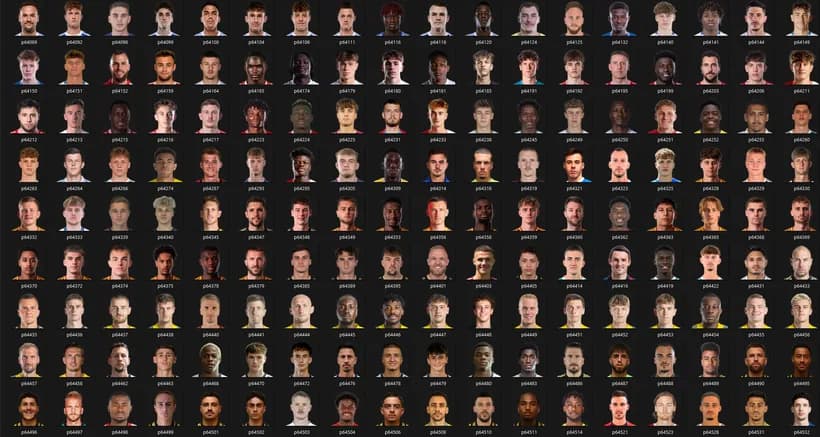
- Fixed abnormally tall 12-year-olds; scout network now finds players aged 13–20
- Academy players can be promoted to the senior team from age 15 — like Lamine Yamal at Barcelona
- Platinum talents (potential 85–91) are far rarer; finding one may take 1–2 seasons and serious investment
- Minimum retirement age: 34 for outfield players, 35 for goalkeepers — careers can continue until 42
- Retirement reworked by rating — a 77-rated player at 34 won't automatically quit; 76 and below may consider it
- Rotation players more willing to renew contracts (70–75%); reserve players even more (85–90%)
Tap to enlarge
Scouting & Youth Talent Search
We completely overhauled the scouting and youth recruitment system. In the base game it often felt far too easy — for a relatively small amount of money you could quickly uncover future superstars, sometimes on your very first attempt. We wanted to bring the system much closer to real football. When you hire a scout, you are no longer just bringing in one individual — you are building an entire scouting setup under that scout's leadership, a team that travels abroad to identify talent. This is a serious investment. A 5★ scout costs around €25 million; a 4★ scout around €10 million. Elite youth development is now mainly associated with the strongest clubs, just as in real life. Smaller and mid-level clubs still have affordable options: 1★ from ~€500k, 2★ ~€1.25M, 3★ ~€2M. If you start with a mid-table or weaker club, developing your scouting network becomes a long-term objective — almost like opening another academy branch. Before sending a scout on assignment, you now genuinely have to think twice. Scouting is a real investment: you commit money, time and resources — and success is no longer guaranteed. Youth scouting used to be a low-risk source of easy profit; now it is a proper long-term project with real risk attached.
- Scout pool refreshes every 30 days instead of every 7
- 5★ scouts only available to 5★ clubs
- Dismissing a scout is now much more expensive (roughly ×10)
- Finding a true wonderkid is significantly harder
- Top talent chance: ~1% for 1–2★ scouts, ~8% for 5★ scouts
- Attribute-based scouting filters are more demanding
- Academy player age range expanded from 12 to 20
- Maximum academy size increased to 30 players
- Academy promotion from age 15; minimum academy contract length 1 year
- 12–14-year-olds no longer spawn with unrealistic 60+ ratings
- More realistic academy departure chances based on age (16–21)
- Scouting observation time significantly reduced — modern analytics speed up evaluation
- Platinum talents extremely rare (0–1%); Gold less often (2–5%); Silver moderate (8–30%)
- Majority of academy players are Bronze-tier prospects; Gold and Platinum are much stronger when found
- Training growth slower and more realistic; Excellent-result bonus reduced
- Difficult drills give smaller extra boost; young players receive smaller development bonus
- XP gain reduced by around 30%
Tap to enlarge
Transfer Market & Contracts
We heavily reworked the transfer market and contract system. Player prices, wage levels and negotiation logic have all been adjusted — securing a good deal is no longer quite so easy. In real football a transfer is not just about numbers: loyalty, time at the club, contract conditions and even the country a player plays in all influence whether a move happens. Players who spent 2–5 years at the same club are less likely to agree to leave. Loyal players and veterans are much harder to prise away. Many high-potential talents now carry release clauses, making them more expensive and difficult to sign — especially for top clubs. Negotiations progress naturally: clubs counteroffer more often, talks take longer, and players are less likely to accept just any offer. The market feels alive — every deal is negotiation, compromise and long-term strategy.
- Loyal players less likely to join another club; veterans and captains significantly harder to sign
- Long club history has stronger impact on transfer decisions
- Players prefer staying in their own country; shared nationality with club matters more
- Star players harder to keep; mid-level players more likely to renew
- In negotiations, wages can be lowered by 10–20%
- Contract expiry reminders 180 days in advance instead of 90
- Age 38 treated as veteran threshold; final transfer window day lasts 24 hours
- Free agent pool significantly reduced — top players rarely left without a contract
- Clubs more likely to renew deals for strong players
- Loan deals harder; loaning clubs cover only 40% of wages (was 50%)
- Loan recall periods increased to 12 or 21 days
- Star player wages (78+) up ~20–30%; superstars (86+) up ~50–55%
- Goalkeeper wages closer to outfield players; strikers earn slightly more on average
- Wages in Europe's top 5 leagues increased; Saudi clubs offer much higher contracts
- Clubs more likely to counteroffer instead of walking away after a low bid
- Players accept equal wages or small raises (+10%); may counteroffer instead of ending talks
- Wage negotiations can resume next day instead of waiting a week
- AI negotiates more rationally; response times 2–5 days in window, 7–12 days outside
- Release clauses especially common in Spain (La Liga and Segunda)
- Player swap deals less frequent; sell-on percentages more common
- Young players 17–24 more expensive (+20% to +45%); high-potential players valued much higher
- Veterans 31+ noticeably cheaper
Tap to enlarge
Transfer Value by Potential
The transfer value of young players with high potential has been completely reworked. Previously, player value was based mainly on current overall rating — you could sign future stars for pocket change and flip them for tens of millions a few seasons later. Now potential plays a much larger role in pricing. Highly promising talents cost significantly more from the start, release clauses appear more often, and the easy wonderkid flip is gone. Building a squad through smart scouting and patient development replaces exploiting the market.
- Player value now driven heavily by potential, not just current overall
- Cheap wonderkid signings are no longer the default market behaviour
- High-potential youngsters priced to reflect long-term upside
- Transfer decisions must account for true development value, not today's rating alone
Tap to enlarge
Match Simulation
We introduced a number of small but important changes to match simulation — for AI vs AI games and matches involving the player. Results, player statistics and season outcomes look far more realistic. Simulated matches better reflect player attributes, in-game situations and the impact of key match events. Top scorer and assist charts become believable; team behaviour in simulation feels closer to real football.
- Shots on target carry more weight than possession
- Teams that create more chances are more likely to win
- Less meaningless possession without real attacking danger
- Assists influence match ratings as strongly as goals
- Red cards have much bigger negative impact on player ratings
- Up to 12 cards possible in a simulated match; red cards more frequent
- Second-yellow reds slightly more common
- AI more likely to make double substitutions and active half-time changes
- Tired players almost always replaced
- AI no longer receives hidden nerfs against the player's team
- Opponent sharpness and morale on equal footing — matches more competitive
Tap to enlarge
Players — Form, Morale, Fitness & Careers
These changes affect players themselves — not by directly editing overall ratings, but by adjusting deeper parameters that become noticeable over a full Career save. Development, form, age-related decline and long-term behaviour were reworked across the board. Top scorers and assist leaders are shaped by relevant attributes. Form reacts faster to poor performances. Bench players demand minutes. Recovery is slower and rotation matters. Minor injuries occur more often; major ones are rarer but last 6+ months. International duty adds strain. Stars hold level until ~36; goalkeepers age gracefully; regens can appear from 15.
- Top scorers shaped by finishing and heading; assist leaders by vision, passing and crossing
- Form reflects real performances; poor matches drop form faster
- Inconsistent performances have stronger impact; sharp jumps at 70→71 removed
- Faster growth between 55–70 overall; smoother progression from 71–99
- Bench players react strongly to lack of game time; missing key matches drops morale
- Players more likely to demand regular minutes
- Recovery after matches slower — squad rotation much more important
- Minor injuries (muscle, groin) slightly more common
- Major injuries (ACL, fractures) rarer but recovery 6+ months
- International duty increases injury chance and physical strain
- Congested international calendar has stronger impact on condition
- High level maintained until ~36; real decline closer to 37; gradual attribute drop
- Goalkeepers stay at high level much longer
- Regens from age 15; minimum retirement age 33; goalkeepers until 36
- Star players can continue until 40; 'One Last Big Move' up to age 36
- 'Future Legend' from age 19; requires 88+ potential
Ballon d'Or & Seasonal Awards
Individual awards now reflect what actually matters in modern football. Winning the UEFA Champions League carries the highest weight in Ballon d'Or decisions. League top scorer and assist rankings follow. All top-5 European leagues carry equal weight — the Premier League no longer dominates by default. Players from leagues outside the top 5, including every nation in EUROPEAN MOD 26, have a genuine path to individual glory.
- UEFA Champions League winner weighted highest for Ballon d'Or
- League top scorer ranking is the second most important factor
- League assist ranking is the third most important factor
- All top-5 European leagues equal — no Premier League advantage
- Players from outside the top 5 have a much better chance of winning
Board, Manager & Career Systems
Beyond the headline systems, a large number of smaller settings were reworked — together they make Career Mode more believable overall. The board evaluates managers over a longer horizon. The manager market reacts more naturally. Press conference answers swing dressing-room morale harder. Inbox capacity grows so long saves stay manageable. You can follow 10 simulated leagues instead of 5.
- Follow 10 leagues/competitions in simulation instead of 5
- Board evaluates managers over a longer period; first serious check comes later
- Losing streaks still dangerous, but one bad run less likely to end your career instantly
- AI clubs less likely to sack managers for no reason
- Manager offers remain active for 7 days
- Clubs respond to applications within 3–7 days
- Long-serving managers less likely to leave voluntarily
- Manager nationality affects job opportunities — more offers in home country
- Press conference responses have stronger impact on team morale
- Player reactions to manager comments significantly increased
- Dressing room atmosphere depends more on managerial decisions
- Inbox capacity increased to 40 messages
- Email response time reduced to 3 days
Build a Career Mode save that rewards patience, strategy and smart investment.